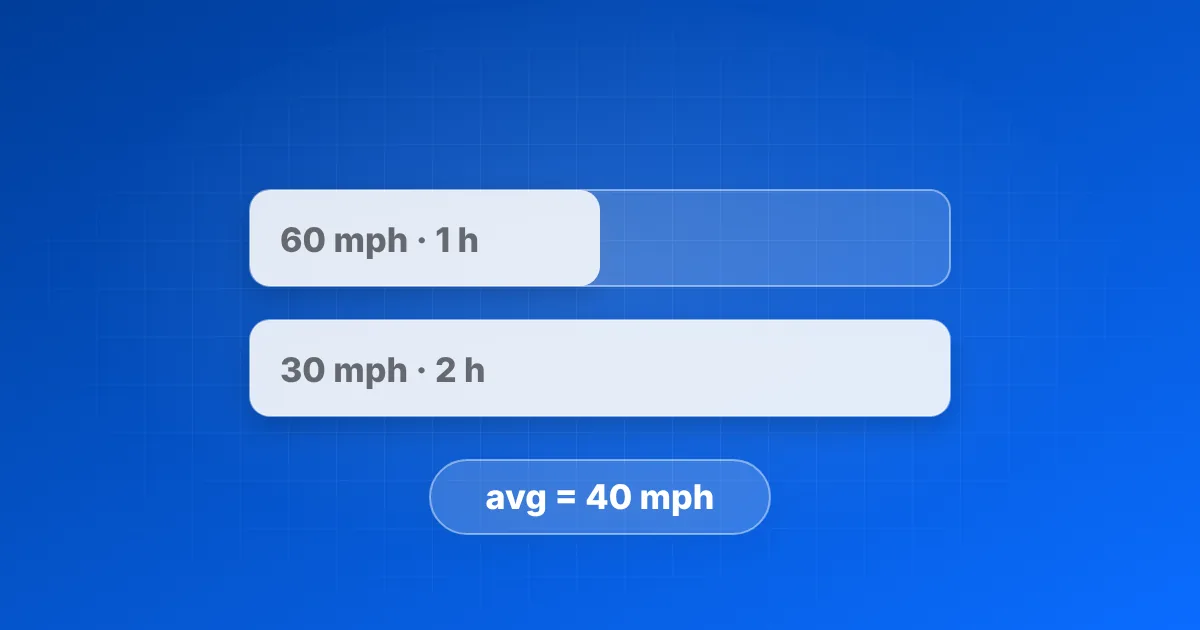
This trick question turns up in maths classes: you drive to a town at 60 mph and return at 30 mph. What was your average speed? The usual guess is 45 mph. The answer is 40 mph.
Work it out with distance and time
Say the town is 60 miles away.
- Out: 60 miles at 60 mph takes 1 hour.
- Back: 60 miles at 30 mph takes 2 hours.
Total: 120 miles in 3 hours, so the average speed is 120 ÷ 3 = 40 mph.
Why the simple average is wrong
You spend twice as long at 30 mph as you do at 60 mph. The slower leg “counts” for more of the trip’s time, so it pulls the average down. A simple average gives each speed equal weight, which is only correct when each speed lasted the same amount of time.
The extreme case
Say you drive out at 30 mph and want a 60 mph average for the round trip. You cannot reach it, however fast you drive back. The outbound leg already used up 2 hours, which is all the time a 60 mph average allows for 120 miles.
The safe rule
Divide total distance by total time. The Multi-leg trip mode in our average speed calculator does this for you, and warns you when a simple average would have given a different answer.
Ready to try it on your own numbers?
Open the calculator