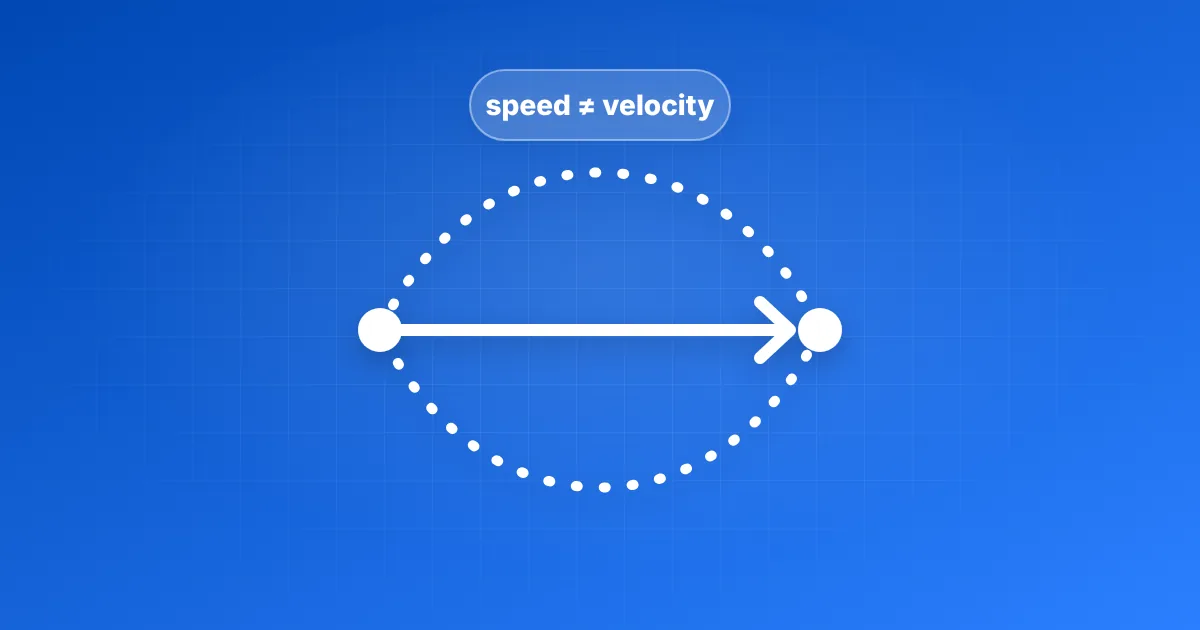
In everyday speech, “speed” and “velocity” mean the same thing. In physics they do not, and the difference matters as soon as you change direction.
Speed is a scalar
Speed only tells you how fast. It has a size but no direction. Average speed is total distance travelled divided by total time.
Velocity is a vector
Velocity tells you how fast and in which direction. Average velocity is total displacement (the straight-line change in position from start to finish) divided by total time.
The round-trip example
You run 5 km out along a straight road and 5 km back, finishing where you started, in 1 hour.
- Distance = 10 km, so average speed = 10 km/h.
- Displacement = 0 km, so average velocity = 0 km/h.
Both numbers are correct. They answer different questions.
Choosing between them
- Average speed is what you want for travel time, fuel planning, running pace and most daily tasks.
- Average velocity matters in physics, navigation and engineering, where the direction of motion is part of the problem.
Can they be equal?
Yes. If you travel in a straight line without turning back, the distance equals the size of the displacement, so the average speed equals the magnitude of the average velocity.
Our calculator works with average speed, the number you need for travel time, pace and fuel.
Ready to try it on your own numbers?
Open the calculator